
The Letter Boxed 2-Word Solution: How to Find It Before Looking It Up
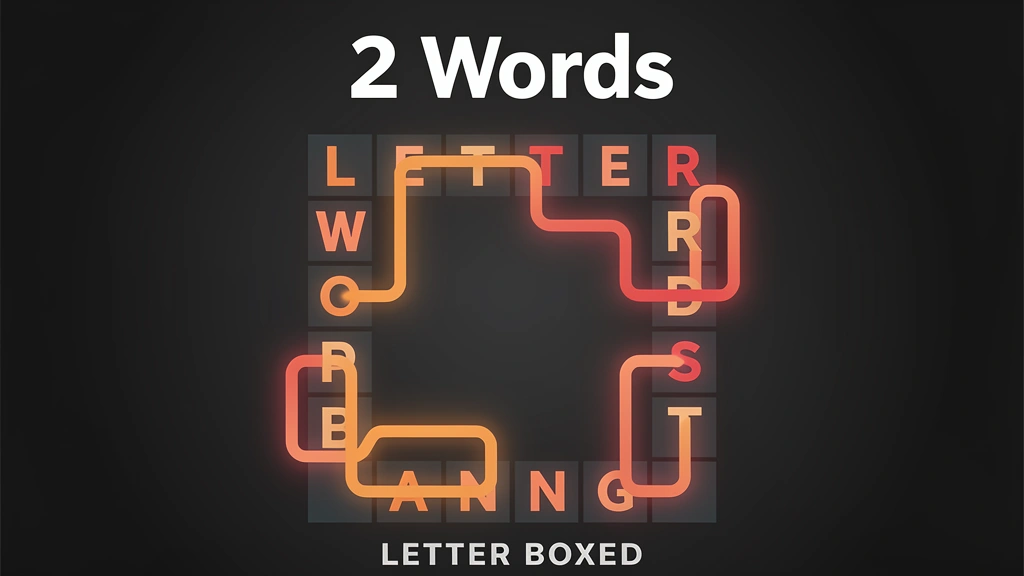
Every Letter Boxed puzzle has a two-word solution. The New York Times guarantees it. The challenge is not whether one exists but how to find it before you give up and check the answer. This guide covers the specific thought process that makes the two-word solution findable through reasoning rather than luck, including the bridge letter method, the long-word approach, and how to read the board for structural clues about where the optimal path lies.
What a 2-Solve Actually Is
A two-word solution, often called a 2-solve or genius solve, means completing the entire puzzle with exactly two words. Word one covers several letters and ends on a bridge letter. Word two starts from that bridge letter and covers all the remaining letters. Together, they account for all twelve letters on the board with no leftover coverage gaps.
The NYT reveals the previous day's two-word solution each morning when the new puzzle launches. This means you can always study the optimal path for any puzzle you could not solve optimally yourself, which is one of the most efficient ways to build long-term Letter Boxed intuition.
Why Two Words Is Harder Than It Looks
The difficulty of the two-word solution is structural, not vocabulary-based. Even a player who knows tens of thousands of English words will struggle with a 2-solve if they approach it word-by-word. The problem is that a two-word solution requires both words to be chosen simultaneously in terms of their combined coverage, not sequentially as independent choices.
Word one must be long enough to cover most of the board and must end on a letter that begins a valid second word. Word two must start from that specific endpoint and cover precisely the letters word one left behind, while also following the edge-alternation rule throughout its own construction. The number of word pairs that satisfy all those constraints simultaneously is small, which is why finding the 2-solve requires a fundamentally different approach than simply finding any valid word to play next.
Method One: Start With the Longest Word You Can Find
The most direct approach to finding a 2-solve is to begin with the longest valid word you can construct on the board. A word of seven, eight, or nine letters will cover more than half the board in one move, leaving only three to five letters for the second word.
Scan all twelve letters and look for long words that can be assembled while respecting the edge rule. Pay attention to common long-word patterns: words ending in -TION, -MENT, -NESS, -LING, and -ABLE, as well as words with common prefixes like UN-, RE-, OUT-, and OVER-. Once you identify a candidate long word, note what letter it ends on and check whether any word starting with that letter covers the remaining uncovered letters.
The endpoint of your long first word is the most constrained variable in the system. Once it is fixed, the second word is either findable or it is not. If you cannot complete the 2-solve from a given endpoint, try a different long word with a different endpoint before assuming no two-word path exists.
Method Two: Work Backward From the Remaining Letters
Once you have tried a few long-word combinations forward without success, shift to a reverse approach. Look at the twelve letters and ask what group of three to five letters could plausibly form the tail end of a second word. Identify which letters seem hardest to reach, typically the ones on edges with limited vowel support, and think about what words could end by using those letters.
From there, work backward to find a first word that ends on the starting letter of that tail-end word. This reverse method tends to surface two-word solutions that forward thinking misses, because it focuses attention on the constraints at the end of the chain rather than the beginning, where most players naturally direct their effort.
The Bridge Letter: Why It Determines Everything
The bridge letter is the endpoint of word one and the mandatory start of word two. Choosing it well is the single most important decision in a two-word solution attempt. A strong bridge letter is one that begins many English words of varying lengths: S, T, R, N, L, and common vowels like A and E all open access to a wide range of continuations.
A bridge letter that is Q, X, J, or Z is almost never viable in a two-word solution because too few words begin with those letters. When scanning for a first word, filter your candidates by their endpoints before you evaluate their coverage. A nine-letter first word ending on J will almost never lead to a two-word solution regardless of how many letters it covers, while a seven-letter first word ending on S or T has far more viable second-word continuations even if it leaves more letters for word two.
Reading the Board for 2-Solve Clues
Some boards make two-word solutions easier to see than others. Boards where vowels distribute across three or four edges provide more routing flexibility, which typically means more valid long words exist and more valid second words are reachable from common bridge letters. Boards where three or four vowels cluster on two edges are structurally harder because every word must repeatedly cross those vowel edges, constraining the available paths.
When vowels cluster, look for the longest possible words that begin and end on non-vowel edges. These words route through the vowel edges in the middle and leave you positioned at a consonant edge for word two, which often provides strong bridge letters. The vowel edge distribution is the single clearest board-level signal about how the 2-solve is likely structured on any given day.
What to Do When You Are Stuck
If you have tried the forward and reverse methods and still cannot find the 2-solve, change your focus from words to edges. Pick the edge with the most uncovered letters and ask what words could start from your current endpoint and reach a letter on that edge within the first few positions. Often the path to the 2-solve runs through an edge you have been avoiding because it seemed difficult to access.
The daily archive on this site shows every past answer. Studying a week of past two-word solutions teaches you the types of words the NYT tends to use in optimal answers, which sharpens your intuition for future puzzles far more effectively than any individual tip.
Frequently Asked Questions
Does every Letter Boxed puzzle have a two-word solution?
Yes. The New York Times guarantees that every daily Letter Boxed puzzle has at least one valid two-word solution. This is a design requirement, not a coincidence. The NYT reveals the previous day's two-word solution each morning, confirming the guaranteed optimal path for every puzzle in the archive.
What is a 2-solve in Letter Boxed?
A 2-solve means completing the Letter Boxed puzzle using exactly two words that together cover all twelve letters on the board. Word one ends on a bridge letter that begins word two, and word two uses all the letters word one did not cover. It is the optimal result in the game and is sometimes called a genius solve by the player community.
How long should the first word be in a two-word solution?
Typically seven to nine letters. The first word needs to cover enough of the board that the second word can reach the remaining three to five letters from a fixed starting point determined by word one's endpoint. Very short first words leave too many letters for word two to handle, and very long first words may leave only one or two remaining letters that are difficult to start a second word with.
Can I find the two-word solution without a solver?
Yes, and most regular players do. The key is looking for long first words that end on common word-starting letters, then checking what words can start from that endpoint and cover the remainder. The game confirms each word as you enter it, so you can experiment with multiple first words at no cost. Many players find the 2-solve through a combination of one strong candidate long word and systematic endpoint evaluation.
Related Letter Boxed Guides
Understanding the two-word solution requires a solid grasp of the underlying rules. The how-to-play guide covers the complete rule set including the edge-alternation constraint, the chaining mechanic, and what the board geometry means for word construction.
For the broader strategic context around chain planning, endpoint selection, and the reverse-solving method, the strategies and tips guide covers each technique with practical examples organized by skill level.
If you want to use a tool to verify your solution attempts or study optimal paths after the fact, the solver guide reviews the most accurate Letter Boxed tools and explains how to use them productively rather than as simple answer machines.