
Every NYT Game Ranked by Difficulty, Time and Vocabulary Demand (2026)
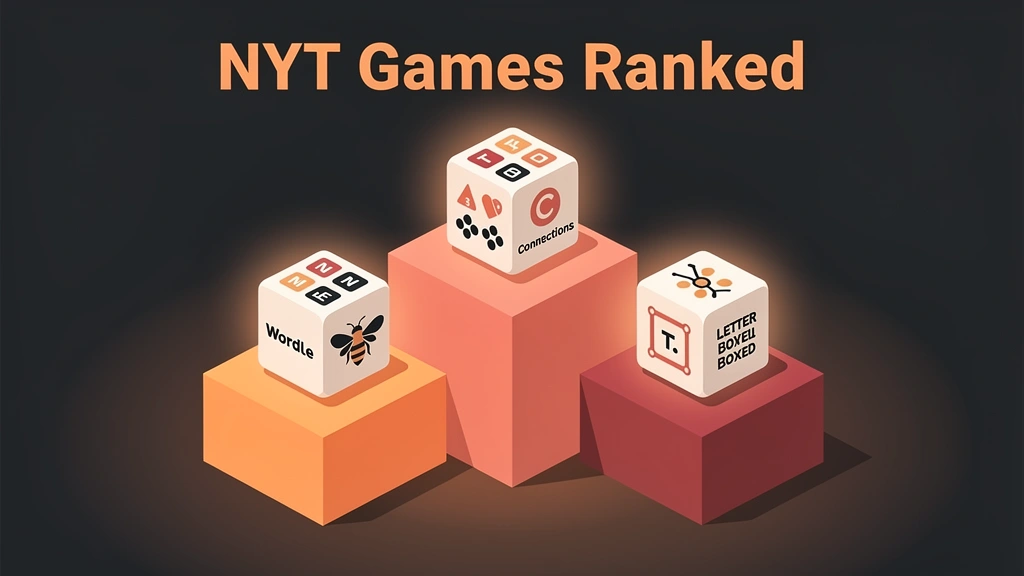
The New York Times now offers nine distinct daily games, and picking which ones to play requires understanding what each one actually asks of you. Difficulty is not one-dimensional. A game that is brutally hard for vocabulary reasons might be trivially easy from a logic standpoint, or vice versa. This ranking uses four criteria: daily time commitment, vocabulary demand, strategic depth, and the difficulty of achieving the optimal result rather than just any completion.
How This Ranking Works
Each game is evaluated on four dimensions. Time per day reflects the average session for a regular player. Vocabulary demand measures the breadth and depth of English word knowledge the game rewards. Strategic depth captures how much planning, pattern recognition, and puzzle-solving skill matters beyond vocabulary alone. Optimal result difficulty measures how hard it is to achieve the best possible outcome, not just to finish the puzzle at all. The ranking reflects average experience across skill levels.
1. Mini Crossword: The Daily Warm-Up
The Mini Crossword is a five-by-five grid with eight to ten clues, most of which draw on general knowledge and common vocabulary. Regular players complete it in under three minutes. The clues are accessible by design, the format allows partial completion to unlock crossing letters through the intersecting structure, and there is no time pressure or penalty for wrong entries. Its low barrier makes it universally completable, which limits its ceiling as a skill development tool but makes it the natural daily warm-up for everything that follows.
2. Wordle: Intuitive and Beautifully Constrained
Wordle asks you to identify a five-letter word in six guesses using color-coded feedback that tells you which letters are correct, present but misplaced, or absent entirely. The solution space is bounded, the feedback loop is tight, and the vocabulary ceiling is modest because most Wordle answers are common, familiar words. Strategic approaches like opener optimization give players a meaningful edge, but the game remains accessible at any skill level. Most players solve it in four guesses on average, with three being the marker of a strong result.
3. Connections: Deceptively Tricky Categories
Connections presents sixteen words sorted into four categories of four. The challenge is that words often appear to belong to multiple categories simultaneously, and the fourth purple category is always designed to mislead. The vocabulary demand is moderate, but the lateral thinking and misdirection-resistance required is significant. Players who approach it systematically by identifying the most obvious group first and using eliminations to reveal the harder ones perform significantly better than players who rely on intuition alone.
4. Strands: Themed Word Searching
Strands is a word-finding game on a six-by-eight grid where all words relate to a daily theme and every letter in the grid is used exactly once. A bonus spangram word spans the full board and reveals the theme. Moderate vocabulary demand, moderate spatial reasoning, and a consistent theme to guide your search make Strands approachable without being trivial. The difficulty depends heavily on how quickly you identify the theme, which then guides all subsequent word finding.
5. Letter Boxed: Harder Than It Looks, Better Than It Seems
Letter Boxed sits at the center of this ranking because it combines multiple difficulty dimensions simultaneously. It requires vocabulary, spatial reasoning around the edge-alternation rule, and multi-step chain planning. No other NYT game asks for all three at once. The difficulty is specifically located in the gap between completing the puzzle in many words and completing it optimally in two. Any player with a solid vocabulary can eventually use all twelve letters given enough words. Consistently finding the two-word solution requires an additional skill set built through deliberate practice over weeks of daily play.
Letter Boxed is uniquely rewarding among NYT games because its skill ceiling is high enough to keep improving at for months, while its daily completability is guaranteed by the format. Every puzzle is solvable; the question is only how elegantly you find the path through it.
6. Spelling Bee: The Vocabulary Endurance Test
Spelling Bee provides seven letters, one of which must appear in every word, and asks you to find as many words as possible. The Genius threshold requires reaching 70% of the total available points. Queen Bee requires finding every valid word, which can run to several hundred in a large puzzle. The vocabulary demand of Spelling Bee exceeds every other NYT game. It heavily rewards obscure but valid words, and the Genius and Queen Bee thresholds require knowledge of word patterns, suffixes, and non-common vocabulary that most players must deliberately build over time.
7. Vertex: Logic Without Language
Vertex is a newer addition to the NYT suite focused on visual graph-theory puzzles where players connect nodes according to specific rules. The vocabulary demand is minimal, but the spatial and logical reasoning required is high. It occupies a different cognitive space than the word games and functions more like a daily logic puzzle than a language challenge. Players who approach it with structured reasoning consistently outperform those who rely on visual intuition alone.
8. Full NYT Crossword: The Expert Tier
The daily crossword is the benchmark against which all other word games are measured. Monday puzzles are accessible; Friday and Saturday puzzles require encyclopedic cultural knowledge, wordplay sophistication, and pattern recognition built over years of solving. Average daily time ranges from four minutes for speed solvers on Monday to over an hour for beginners on Saturday. The skill ceiling is effectively unlimited, and the game rewards knowledge breadth that no other NYT puzzle tests in the same way.
9. Tiles: Pattern Matching in a Different Register
Tiles is a matching and arrangement puzzle that operates more like a casual mobile game than a vocabulary challenge. The difficulty varies significantly by session, and the skill involved is spatial pattern recognition rather than word knowledge. It has a smaller dedicated community than the other NYT games and is among the newest additions to the suite. Players who enjoy logic and visual puzzles over word challenges tend to find it rewarding; players approaching it expecting a word game are often surprised by the format.
Where Letter Boxed Fits in Your Daily Routine
For players interested in building word skill progressively, the optimal daily sequence is Mini Crossword for a warm-up, Wordle for one focused deduction session, and Letter Boxed as the primary vocabulary and strategy workout. Adding Connections and Strands on days with more time provides variety without significant additional cognitive load. Spelling Bee works best as a standalone practice session when you have ten to twenty minutes available rather than as a quick daily addition alongside the other games.
Frequently Asked Questions
What is the hardest NYT game?
The full daily NYT Crossword is broadly considered the hardest, requiring encyclopedic knowledge, wordplay literacy, and cultural reference breadth accumulated over years. Among the standalone word games specifically, Spelling Bee's Queen Bee threshold and Letter Boxed's two-word solution are the most difficult daily achievements to reach consistently. Both require skills built through sustained daily practice rather than occasional inspired performance.
Which NYT game takes the least time per day?
The Mini Crossword is the fastest, with average completion under three minutes for regular players. Wordle follows at three to five minutes for most players. Letter Boxed varies most dramatically by skill level of any game on this list: advanced players who know how to target bridge letters and long words can complete it in under two minutes, while beginners working through the puzzle step by step often spend fifteen minutes or more.
Is Letter Boxed harder than Wordle?
Yes, for most players. Wordle has a clear, bounded solution space and a consistent feedback loop that tells you after each guess exactly which information to use next. Letter Boxed requires open-ended word construction under a spatial constraint with no intermediate feedback until a word is completed. The optimal solution in Wordle is findable through systematic elimination of possibilities; the optimal solution in Letter Boxed requires planning a chain of words where the endpoint of each determines all future options, with no guided hints along the way.
Which NYT game is best for improving vocabulary?
Spelling Bee develops vocabulary breadth most aggressively because it rewards knowing many words from a seven-letter set across all word lengths, pushing players toward uncommon but valid terms they would not encounter in everyday use. Letter Boxed develops a complementary but different skill: recognizing which words can be physically constructed on a constrained board, which over time biases players toward longer and less common words that happen to route well across multiple edges.
Related Letter Boxed Guides
If this ranking made you want to improve at Letter Boxed specifically, the how-to-play guide covers every rule and mechanic from the beginning, including why the edge-alternation constraint makes the game structurally different from every other word puzzle.
For the specific techniques that separate two-word solvers from the rest, the strategies and tips guide covers the bridge letter method, reverse solving, and the long-word priority approach organized by experience level.
If the two-word solution is your primary goal, the dedicated two-word solution guide explains how to read the board structure, evaluate bridge letters, and apply the reverse-solving method to find the optimal path before looking it up.